Importing a car from Germany is worth it for three reasons: there is far more choice than in Spain, cars tend to be better equipped and better maintained, and in the mid-range and premium segments the purchase price is lower. What is not worth it is doing it blind: the savings evaporate with a miscalculated registration tax, a car with a dubious history or a registration agent who takes two months.
This is what we do on every import, step by step, so you know what to expect even if you do not do it with us.
1. Choosing the car: where to look and what to check
The go-to German sites are mobile.de and AutoScout24. Both let you filter by dealer, mileage, first registration and, very importantly, by whether VAT is deductible (“MwSt. ausweisbar”). That detail changes the real price more than any haggling, as we will see in the VAT section.
Before you fall for a listing, check:
- Who is selling. A franchised dealer or a trader with years in business. A private seller can be a good option, but the purchase is more delicate (payment, warranty, paperwork).
- History and maintenance. Service book, invoices and, if possible, a report from the manufacturer. In Germany there is also the roadworthiness report (TÜV/DEKRA) with the date of the next inspection.
- Documents from the country of origin. The car must come with both parts of the registration certificate (Zulassungsbescheinigung Teil I and Teil II). Without part II it cannot be registered in Spain.
- Certificate of Conformity (COC). If the car is European and has a COC, homologation in Spain is a formality. Without a COC you need a reduced data sheet or an individual approval, which costs time and money.
- CO2 emissions (WLTP). They determine the registration tax. Ask for the exact figure from the technical documentation; do not trust the one in the listing.
2. Inspecting the car at source
You do not buy a car 1,500 km away from photos. We inspect it in person or through trusted inspectors in Germany: mechanics, bodywork, electronics, genuine mileage and whether the chassis number matches the paperwork. It is the step that saves the most heartache, and the one most people skip.
3. Buying and paying safely
The sale contract (Kaufvertrag) must state the seller’s identity, chassis number, mileage, price, VAT scheme and delivery date. Payment is made by bank transfer against handover of the original documents, never in advance to an unknown private seller. With large dealers it is usual to pay into the company’s account after signing the contract and before collection.
4. Getting the car here: export plates or transport
There are two ways to bring it over:
- Driving it on export plates (Ausfuhrkennzeichen), which include temporary insurance. This works if you want to make the trip, but it adds mileage, risk and days.
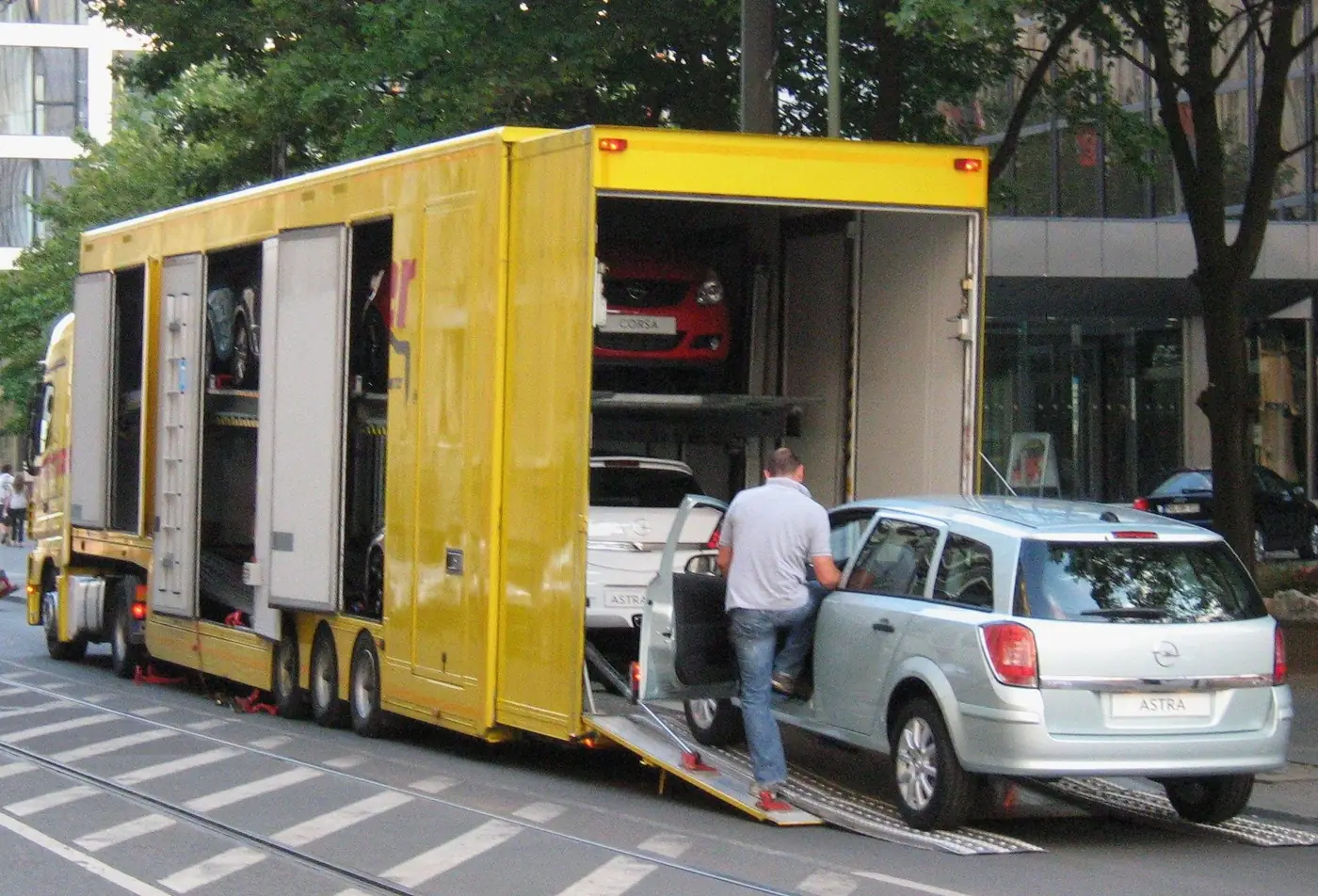
- Transport by lorry, open or enclosed, with collection from the dealer and delivery to your door. This is what we do by default: the car arrives insured and without adding any miles.
5. Taxes: what you really pay
This is the part that causes the most confusion. There are three separate items:
VAT
- Used car bought from a private seller or under the margin scheme (“MwSt. nicht ausweisbar”): German VAT is already included in the price and no Spanish VAT is payable. This is the most common case with used cars.
- Used car with deductible VAT (“MwSt. ausweisbar”): if the buyer is a Spanish company with an intra-EU VAT number, it buys without German VAT (an exempt intra-EU supply) and accounts for VAT in Spain. A private individual cannot use this route and pays the gross price.
- A “new” car for tax purposes (under 6 months old or under 6,000 km): VAT is payable in Spain even if it comes from a private seller, using form 309, and the German seller should invoice without German VAT.
Spanish registration tax (IEDMT)
It is paid to the Spanish tax office (Hacienda) using form 576 before registration, and depends on the official CO2 emissions under the WLTP cycle:
| WLTP emissions | Rate |
|---|---|
| Up to 120 g/km | 0% |
| 121 to 160 g/km | 4.75% |
| 161 to 200 g/km | 9.75% |
| Over 200 g/km | 14.75% |
The rate is applied to the car’s taxable value, which Hacienda calculates from its retail price when new, reduced according to its age (the tables are published every year), and not to what you paid. That is why a ten-year-old sports car at 250 g/km may pay less than you would think, and a recent hybrid SUV at 130 g/km more than you would expect.
DGT fees and ITV
Registration with the DGT (the Spanish traffic authority) carries a fee of around €100, plus the cost of the number plates. Before that, the car goes through a pre-registration ITV (the Spanish equivalent of the MOT), where the documents are checked and the Spanish technical data sheet is issued. With a COC it is a standard inspection; without one, homologation may require a laboratory and several hundred euros more.
6. Registering: the right order
- Pre-registration ITV with the original German documents and the COC.
- Pay the registration tax (form 576) and, where applicable, VAT (form 309).
- Municipal road tax (IVTM) at your local town hall.
- Registration application at the DGT with all of the above. You receive the Spanish registration certificate and the plates are ordered.
With the paperwork in order, the whole process usually takes two to three weeks from the moment the car arrives in Spain. Delays almost always come from a missing COC, a part II of the registration certificate that the seller did not hand over, or a distant ITV appointment.
A rough example
A four-year-old diesel estate bought from a German dealer for €24,000 under the margin scheme, at 135 g/km WLTP and with a price of €42,000 when new:
- Purchase: €24,000 (no additional Spanish VAT).
- Transport by lorry to Barcelona: varies by route and type of lorry; ask for it as a fixed figure in the proposal.
- Registration tax: 4.75% of the taxable value, which at four years old will be well below the original €42,000.
- ITV, DGT fees and plates: a few hundred euros.
- Registration agent: depending on who handles it.
Mistakes we see all the time
- Calculating the registration tax with the CO2 figure from the listing rather than the one on the technical documentation.
- Buying an “almost new” car without knowing it is taxed as new and that VAT has to be paid in Spain.
- Paying without having part II of the registration certificate in your hand.
- Discovering there is no COC once the car is already in Spain.
- Choosing the car on the listing price alone, without comparing the total registered cost.
Is it worth doing with someone?
If it is your first import, almost always. Not because of the paperwork, which can be learnt, but because of the part that is not in any manual: knowing which German dealers are reliable, negotiating in their language, spotting a car with a doctored history and having the tax worked out correctly before committing a single euro. It is what we have been doing since 2005.
If you would like us to tell you what the car you have in mind would cost, registered and at your door, tell us about it in two minutes under Import.